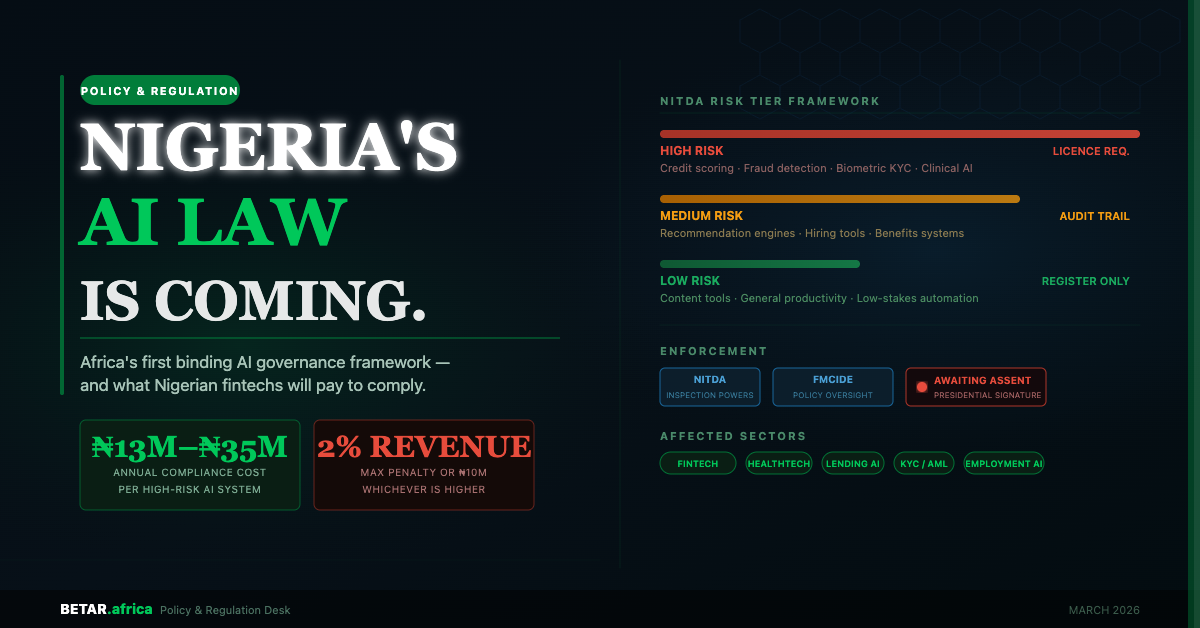
President Bola Tinubu signed the National Digital Economy and E-Governance Bill into law on 27 March 2026, making Nigeria the first country on the African continent to enact binding legislation governing artificial intelligence. The law, which passed both chambers of the National Assembly earlier this year, gives Nigeria’s National Information Technology Development Agency sweeping powers to license, audit, and penalise AI systems operating in high-risk sectors of the economy.
The new law — widely referred to as Nigeria’s AI Act — creates a risk-tiered framework for AI governance modelled on international best practice. High-risk AI applications, including credit-scoring models, automated fraud detection systems, biometric identity verification used in financial services, and AI-assisted clinical tools, will require mandatory licensing from NITDA before deployment. Companies operating such systems must conduct pre-deployment impact assessments, maintain auditable decision logs, and meet transparency requirements that allow affected users to understand how automated decisions were made about them.
Non-compliance carries penalties designed to be material at scale: fines of up to ₦10 million (approximately $7,000 at current exchange rates) or two percent of a company’s annual Nigeria-attributed revenue — whichever is higher. For a fintech generating ₦2 billion in annual revenue, the maximum exposure is ₦40 million. NITDA retains powers to revoke operating licences and mandate product shutdowns in cases of serious or persistent non-compliance.
NITDA Director General Kashifu Inuwa Abdullahi has been the bill’s primary executive champion. The agency is expected to publish implementing regulations within 90 days of assent, with full enforcement beginning six months after that. The bill also empowers NITDA to establish regulatory sandboxes — controlled environments where startups may test AI products under government supervision before seeking full licensing. Whether those sandboxes will provide meaningful relief from compliance overhead is unclear: the law contains no revenue-tiered track, no phased enforcement schedule, and no permanent lighter-touch regime for early-stage companies. The sandbox solves the testing problem; it does not solve the production compliance problem.
Nigeria’s fintech sector — which has built much of its infrastructure on algorithmic credit models, AI-native KYC pipelines, and machine-learning fraud classifiers — faces the most immediate compliance pressure. Analysis by Lagos-based digital governance firm Datum Africa estimates that a mid-sized Nigerian fintech with three high-risk AI systems in production will face annual compliance costs of between ₦13 million and ₦35 million under the new regime. For early-stage startups, those figures represent a structurally higher cost burden relative to revenue.
The law contains no startup-specific carve-outs or revenue-threshold exemptions — a gap that Nigerian tech industry groups lobbied to address during the bill’s passage through the National Assembly.
Nigeria joins South Africa, Kenya, and Egypt as African nations actively building AI governance frameworks, but moves further than all three: those countries have published guidelines, strategies, or advisory notes. Nigeria now has an enforceable law.
BETAR.africa has published a full compliance analysis: Nigeria’s AI Law: What It Will Cost to Comply — and Who Gets Left Behind.